
You are interviewing a driver who appears to be a good fit for your company. Maybe you run the required pre-employment Clearinghouse query and discover a drug or alcohol violation in their history, or maybe the applicant is upfront about it during the interview and tells you that they have already been working through the return-to-duty process.
At that point, the question is not necessarily whether the driver can ever work in a DOT-regulated position again. A Clearinghouse violation does not automatically end someone’s ability to return to safety-sensitive work. There is a process for that. The more important question for the employer is whether you understand what your company may be taking on if you decide to move forward.
Start With the Driver’s Current Status
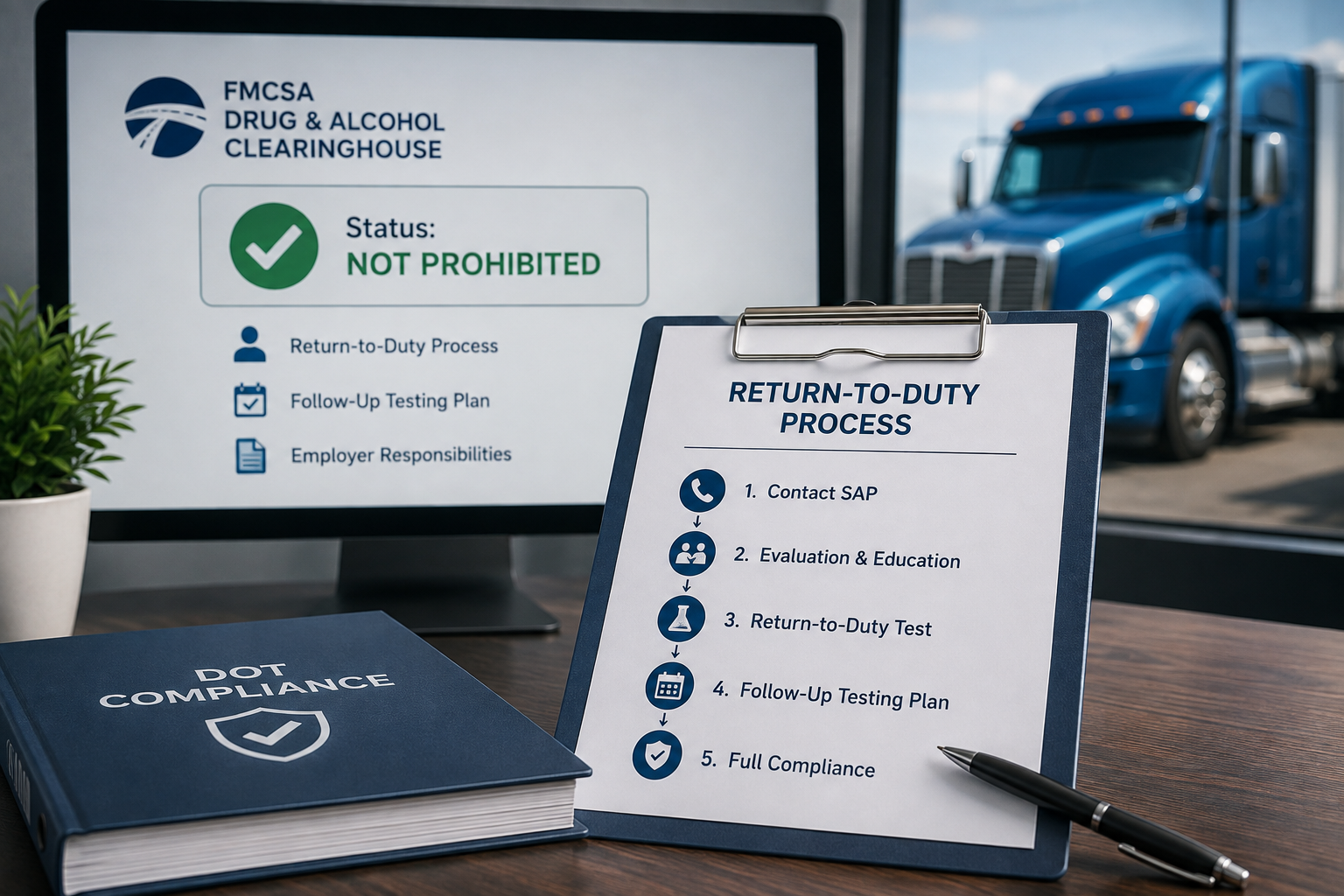
The first thing to determine is the driver’s current Clearinghouse status. Are they currently Prohibited, or are they Not Prohibited?
If they are still Prohibited, they cannot perform FMCSA-regulated safety-sensitive functions. That does not necessarily mean you cannot continue the hiring process, but it does mean you need to know where they are in the return-to-duty process before making assumptions about when they can actually begin driving.
One applicant may have had a violation several years ago, completed the required process, returned to safety-sensitive work, and now show as Not Prohibited. Another may have completed the SAP’s recommended education or treatment and be ready for a return-to-duty test but still be listed as Prohibited. A third may only be at the beginning of the process.
Those are very different situations, and an employer should know exactly which one they are dealing with before agreeing to anything.
What If the Applicant Is Still Prohibited?
If the applicant is still Prohibited but has already completed the required SAP steps and is ready for a return-to-duty test, your company may decide that it is willing to help move the process forward.
That is where some employers can unintentionally take on more responsibility than they realized.
If you agree to arrange the return-to-duty test, who is ordering it? Who is receiving the result? Who is responsible for making sure the correct test type is used? Who is handling the Clearinghouse reporting responsibilities? And does your DER understand what is supposed to happen after the result comes back, especially if it comes back positive?
The employer does not necessarily need to be afraid of the process, but they should understand what it is agreeing to manage before telling an applicant, “Yes, we’ll help you through it.”
The Return-to-Duty Test Is Usually Not the End
It is also important to remember that the return-to-duty test is not usually the end of the process.
A driver who completes the return-to-duty requirements will be subject to a SAP-prescribed follow-up testing plan. That means an applicant can show as Not Prohibited and still have additional testing obligations that your company will need to manage once they are performing safety-sensitive work for you.
This is where employers should look beyond the Clearinghouse status itself. A Not Prohibited result does not necessarily mean there are no remaining responsibilities.
If there is an active follow-up plan, your company needs to know how much of that plan remains, who has the SAP documentation, who will manage the testing schedule, and whether your current C/TPA agreement actually includes return-to-duty and follow-up testing services.
Review Your Service-Agent Agreements
This is one area where you really should not make assumptions.
It is easy to believe that because a service agent manages your random consortium, they also manage every other DOT testing situation that comes up. That may not be the case.
If your agreement only addresses random testing and general program management, does it also include return-to-duty testing? Follow-up testing? SAP coordination? Tracking the testing plan? Clearinghouse reporting?
If you hire a driver with an active follow-up plan, someone needs to know exactly who is responsible for each part of that process.
This is one of those times when I would actually pull out the agreement with your C/TPA and read what it says instead of assuming the service is included. Better yet, give them a call or send an email to see if this is something they can assist you with.
What Happens If the Driver Doesn’t Show Up?
There are also other common issues that are much easier to address before they happen.
What if the driver does not show up for the return-to-duty or follow-up test? Who gets notified? Who contacts the employee? Who gathers the facts and determines what happened?
A missed test can become a much larger compliance issue if everyone involved assumes someone else is responsible for handling it.
Your DER should understand who needs to be contacted, what information needs to be documented, and what happens next. The next steps change depending on the type of test, as well as the situation around it.
What If There Is Another Positive Test or Refusal?
The same is true if the driver tests positive again or refuses a required test.
At that point, the company should already understand its own internal position. Who communicates with the employee? Who handles the required reporting? Does employment end? Would the company consider allowing the individual to begin the process again?
What does the drug and alcohol policy say? What was communicated to the employee when they were hired?
Those employment decisions are separate from the DOT compliance requirements. DOT regulations determine whether someone may perform safety-sensitive functions and what steps must be completed before they can return. The company still has to decide how it will handle the employment relationship itself, subject to any other applicable laws, policies, agreements, or collective bargaining requirements.
What Has the Company Agreed to With the Employee?
This is another area worth thinking about before the individual starts work.
If you knowingly hire someone who is still completing the return-to-duty process, what has actually been communicated to them?
If the offer is dependent on a negative return-to-duty test, is that clear? Who is responsible for testing costs? What happens if the individual fails to report for a required test? What happens if another violation occurs? Is the offer also dependent on continued negative follow-up tests? And has that agreement been put into place between the company and the employee?
The goal is not to create an unnecessarily complicated agreement. It is to avoid a situation where the employer and employee believed they had agreed to two different things.
Make Sure the Correct Test Is Being Ordered
There is another operational detail that can easily be missed: the correct test has to be ordered.
A return-to-duty test needs to be ordered as a return-to-duty test, and a follow-up test needs to be ordered as a follow-up test. These test types also have specific collection requirements.
Simply telling the collection site that you need a “DOT drug test” on a new driver is not enough if the person ordering the test does not understand what type is actually required.
This is another reason the DER, C/TPA, collection site, and employer need to understand who is responsible for what.
Questions to Consider Before Moving Forward
- What is the driver’s current Clearinghouse status?
- Where are they in the return-to-duty process?
- Do they still need a return-to-duty test?
- Do they have an active follow-up testing plan?
- How much of that plan remains?
- Who has the SAP information and supporting documentation?
- Who will manage the follow-up testing requirements?
- Does our C/TPA agreement actually include return-to-duty and follow-up management?
- Who is responsible for odering the correct test type?
- What happens if the employee does not report for a required test?
- What happens if there is another positive test or refusal?
- What does our company policy say?
- What have we agreed to with the employee?
- Does our DER know how to handle each of these situations?
None of these questions automatically mean that the employer should not hire the driver. They are simply questions that should be answered before the company becomes responsible for managing the process.
A Violation Should Lead to Questions, Not Assumptions
A Clearinghouse violation can lead employers toward two very different assumptions.
The first is, “We can’t hire this person.”
The second is, “They’re Not Prohibited now, so everything must be finished.”
Neither one necessarily tells you the whole story.
A driver may have completed enough of the return-to-duty process to return to safety-sensitive work while still having follow-up testing requirements. Another driver may still be Prohibited but be close to completing the process and need a prospective employer willing to move forward with the return-to-duty test.
Whether you hire that person is ultimately a company decision. The important part is making sure your program is prepared for the responsibilities that come with that decision.
Hiring the driver is one decision. Knowing how to properly manage the DOT requirements that follow is another.
Sources & References
- FMCSA Drug & Alcohol Clearinghouse – Return-to-Duty Process
- 49 CFR § 40.305 – How does the return-to-duty process conclude?
- 49 CFR § 40.307 – What is the SAP’s function in prescribing follow-up tests?
- 49 CFR § 40.191 – What is a refusal to take a DOT drug test?
- 49 CFR § 40.67 – When and how is a directly observed collection conducted?
- 49 CFR § 40.309 – Employer Responsibilities for Follow-Up Testing
Need Help Managing Your DOT Compliance Program?
Occupational Safety On Site assists employers with DOT drug and alcohol testing programs, Clearinghouse compliance, consortium management, supervisor training, and occupational health services throughout New York State.
Contact our team to learn more.
About the Author

Jessica Rabun is the Director of Operations and Compliance for Occupational Safety On Site. She works closely with employers, DERs, transportation providers, and safety professionals to support DOT compliance, FMCSA Clearinghouse requirements, consortium management, workplace testing programs, and occupational health services.
Through On Site & In Compliance, Jessica shares practical guidance, industry insights, and real-world compliance lessons drawn from the challenges employers face every day. Her goal is to help organizations navigate complex regulatory requirements with confidence while building safer, more compliant workplaces.